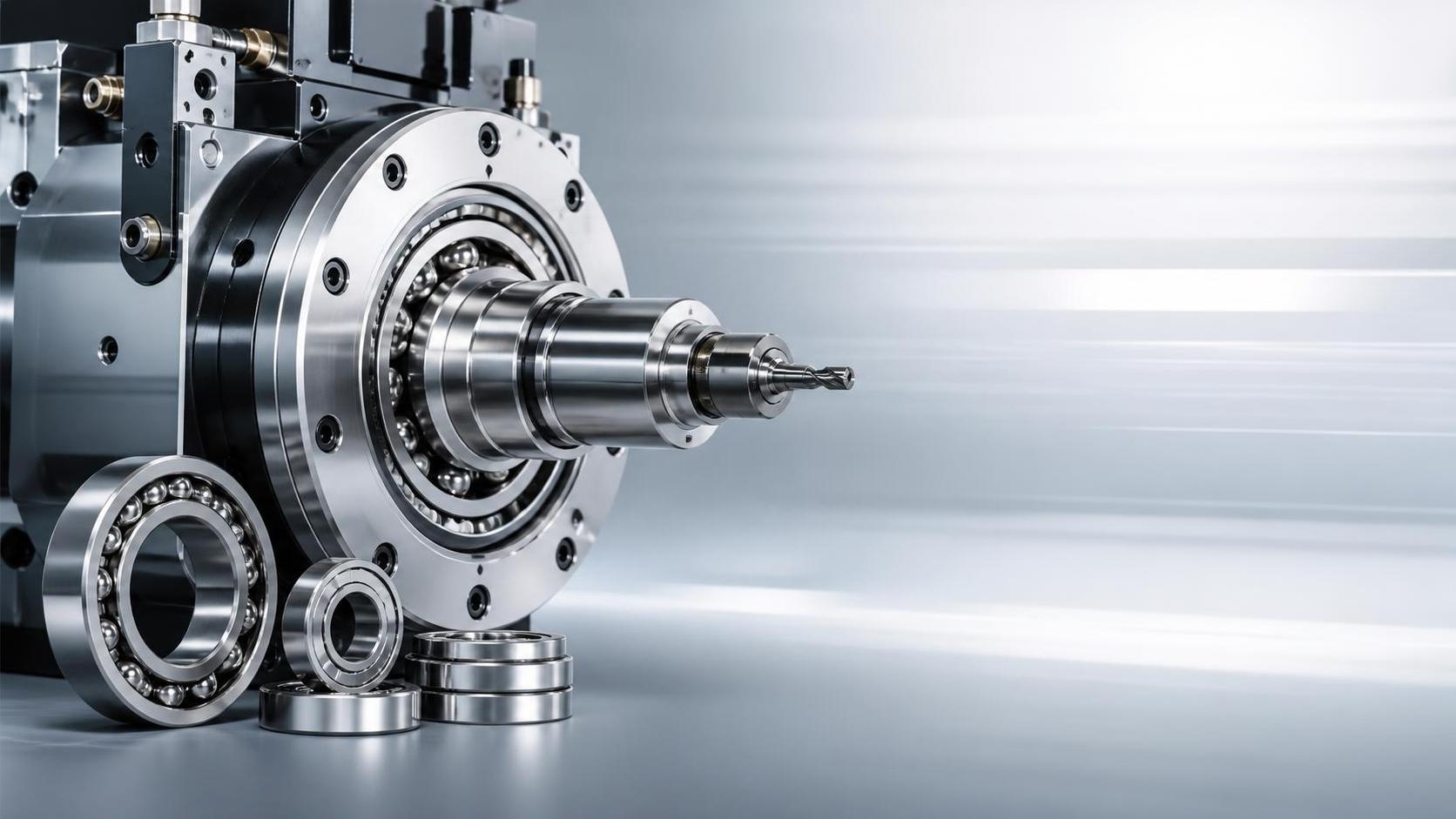
What “suitable” really means in high-speed equipment
For high-speed machinery, a Precision Bearing is not “suitable” simply because it has a tighter tolerance grade or a higher catalog speed value. In real applications, suitability means the bearing can hold its running accuracy, manage heat, preserve lubrication film, and stay stable under the machine’s actual load, mounting, and maintenance conditions. That is a narrower test than many buyers assume.
Technical evaluators usually run into the same issue: a bearing may look technically strong on paper, yet still fail early because the system around it is not aligned with high-speed operation. Speed alone is not the full story. Cage design, internal clearance, preload, lubrication method, shaft and housing precision, and the machine’s thermal behavior all decide whether the bearing will remain stable once the spindle or rotor reaches working speed.
Start with the operating envelope, not the bearing label
The first question is not “Is this a precision bearing?” but “What exactly will it experience in service?” High-speed equipment can mean machine tool spindles, motors, compressors, textile machinery, grinding equipment, or specialty automation systems. These applications do not stress bearings in the same way. Some are dominated by rotational speed and low radial load. Others combine speed with vibration, intermittent shock, temperature rise, or changing axial force.
A bearing is only a candidate if its speed capability matches the real duty cycle, not just peak speed. Many selections go wrong because buyers compare a maximum speed figure without checking whether that figure assumes light load, ideal lubrication, and strict heat dissipation. If the machine runs near the limit for long periods, the bearing should usually be treated more conservatively than the catalog line suggests.
Practical evaluation starts with four inputs: operating speed, load direction and magnitude, temperature range, and required running accuracy. If any of these are unclear, the selection is still premature.
Questions that should be answered before narrowing the model
- What is the continuous working speed, not just the top speed?
- Is the load mainly radial, axial, or combined?
- Will speed be constant, variable, or cyclic?
- Is the machine sensitive to vibration, noise, or thermal drift?
- What lubrication method is available in the structure?
- How much shaft and housing accuracy can the machine really hold?
Speed rating is necessary, but not decisive
Speed rating is the first filter, but it is not a verdict. A precision bearing that survives high rotational speed in one machine may run poorly in another with different preload, grease type, or heat removal. That is why many experienced teams treat catalog speed data as a boundary condition rather than a promise.
At high speed, centrifugal force changes the internal contact state of the bearing. Rolling elements, cage, and lubricant all behave differently as speed rises. If the bearing design is not intended for that regime, heat generation increases quickly, which can accelerate lubricant breakdown and reduce dimensional stability. Once that happens, accuracy losses show up before outright failure does.
For this reason, the useful question is not whether the bearing can rotate fast, but whether it can do so while maintaining acceptable temperature rise and stable preload. If the application requires sustained high RPM, it is better to choose a bearing family designed for that duty than to stretch a general-purpose precision bearing beyond its comfort zone.
Accuracy grade matters, but only inside the full system
Precision bearing buyers often focus on dimensional accuracy, but accuracy alone does not guarantee suitability. A high-grade bearing installed in an inaccurate housing or on a poorly finished shaft will not deliver its nominal performance. In high-speed machinery, the fit-up environment matters as much as the bearing itself.
Running accuracy is affected by roundness, raceway geometry, internal clearance, preload, and mounting quality. If the shaft has excessive runout, or if the housing bore is distorted during assembly, the bearing may run hot or produce vibration even when the bearing itself is within specification. That is one reason technical evaluators should check the bearing as part of a rotating assembly, not as a standalone component.
For machine tools and other precision systems, the practical test is whether the whole assembly can keep stable preload and low vibration at speed. That depends on the interaction between bearing class, mounting method, and thermal growth of adjacent parts. A model that looks ideal in a spec sheet may be poor if the machine design cannot hold the installation tolerances it demands.
Heat resistance is often the real limiting factor
In high-speed service, failure often begins as a thermal problem. The bearing may still rotate, but rising temperature changes clearances, degrades lubricant, and shifts internal contact pressure. If heat is not controlled, speed capability on paper becomes irrelevant.
This is why thermal stability should be reviewed together with material quality and lubrication strategy. The bearing steel, cage material, grease base oil, and sealing arrangement all influence heat behavior. For machines with continuous duty, the evaluator should ask whether the bearing can operate within a stable thermal window under the machine’s actual cooling conditions.
It is also important to distinguish between the bearing’s temperature tolerance and the system’s temperature management. A bearing may tolerate a certain range, but if the surrounding structure expands unevenly, preload can drift. That drift can be more damaging than the temperature itself. In practice, the bearing is suitable only if the machine can dissipate heat fast enough to preserve the intended running condition.
Lubrication is not a supporting detail
Lubrication is one of the most common reasons a seemingly good precision bearing becomes unsuitable for high-speed machinery. Grease that works well at moderate speed may churn, separate, or overheat at higher RPM. Oil lubrication may be more appropriate in some machines, but only if the supply, flow, and cleanliness are controlled. There is no universal answer.
For selection purposes, the key point is that lubrication must match speed, temperature, and maintenance interval together. A bearing that needs frequent relubrication may be acceptable in a plant with disciplined maintenance and monitoring. The same bearing may be a weak choice in a compact machine with limited service access.
Technical evaluators should also consider contamination control. At high speed, small amounts of debris or degraded lubricant can amplify noise, vibration, and wear much faster than in slower equipment. If the sealing system is weak, the nominal precision of the bearing will not be enough to preserve performance over time.
Cage design and internal geometry deserve more attention than they get
Many buyers focus on ring size and load rating, but high-speed suitability often depends on finer design details. Cage design affects stability, friction, heat generation, and rolling element guidance. Internal geometry affects contact angle, preload behavior, and the bearing’s response to thermal growth.
In demanding applications, a bearing that performs well at high speed usually has design features intended to reduce friction and manage dynamic stability. That can include an optimized cage, suitable raceway geometry, and carefully controlled internal clearance or preload. These are not decorative details. They directly affect whether the bearing remains calm or becomes noisy and unstable as speed rises.
Where application conditions are severe or not well standardized, it is better to request application-specific validation than to rely on a generic model description. A supplier should be able to explain why a given bearing structure fits the machine, not only that it is “precision grade.”
Look for the warning signs in the machine, not just in the bearing
A bearing may be technically correct and still underperform because the rest of the machine is not ready for high-speed operation. Evaluators should watch for a few common warning signs during selection and trial runs.
These symptoms matter because they often appear before actual failure. If they are ignored, the machine may still operate for a period of time while producing lower quality output, higher energy loss, or unstable process performance. In high-speed systems, that is often where the hidden cost starts.
How to compare candidates in a procurement review
When several precision bearing options appear technically acceptable, the better choice is usually the one that best matches the machine’s real operating profile, not the one with the largest headline numbers. A practical procurement review should compare how each candidate handles speed, heat, fit tolerance, and lubrication in the same conditions.
For internal evaluation, the following sequence is usually more reliable than a simple price comparison:
- Confirm actual operating speed and duty cycle.
- Check whether the bearing type is intended for sustained high-speed work.
- Review heat generation expectations under the planned lubrication method.
- Verify that shaft and housing precision can support the required class.
- Assess preload or clearance control during assembly.
- Confirm maintenance access, contamination control, and monitoring plan.
A lower-cost bearing may be acceptable if the machine is modest in speed and easy to maintain. In a high-speed line, the cheaper option can become more expensive once downtime, scrap, and rework are included. That is why a bearing should be judged by lifecycle risk, not unit price alone.
Supplier claims should be checked against application reality
Buyers often hear phrases such as “high-speed capable,” “low noise,” or “imported-grade quality.” Those statements can be useful starting points, but they are not enough for technical approval. A credible supplier should be able to explain the test conditions behind those claims: speed range, load condition, lubrication method, temperature control, and measurement criteria.
That level of detail matters because a bearing can be excellent in one environment and unsuitable in another. For example, a model produced with high-precision CNC grinding and tested on specialized equipment may still require confirmation against the actual spindle design or motor arrangement. The bearing’s production quality is important, but application fit is the deciding factor.
For buyers evaluating suppliers such as Liaocheng Tianyue Bearing Co., Ltd. or its subsidiary Anhui Luban Bearing Company, the useful question is whether the manufacturer can support selection with application-oriented technical explanation, consistent quality control, and stable delivery. That is more valuable than broad marketing language. The same applies to any vendor in this category.
What technical evaluators should conclude
A precision bearing is suitable for high-speed machinery only when it can maintain accuracy, thermal stability, and lubrication integrity under the machine’s real working conditions. The decision should be made by testing the full system: speed, load, fit, heat, cage behavior, and maintenance reality. If any one of those pieces is weak, the bearing may still run, but it is not truly suitable.
In practice, the safest selection is usually the one that leaves a margin for assembly variation, thermal growth, and service conditions. That margin is what separates a bearing that merely meets a catalog figure from one that actually supports reliable production over time.
For high-speed machinery, that distinction is the whole decision.

Thank you very much for writing to us. Please leave your message and contact information, we will reply to you within 24 hours.